PlayToEarn










 Plus
Plus



Apple Pulls One of the Top Free Apps in the World
Apple removed Freecash from the iOS App Store on Monday, April 13, 2026, citing scam practices and misleading marketing. Google Play followed within hours. Apple also terminated the developer account behind the listing. The action came after months of warnings from cybersecurity researchers and consumer journalists, and only after a TechCrunch investigation contacted Apple directly for comment.
Apple pointed reporters to App Store Review Guidelines 3.1.2(a) on permissible uses, 3.2.2 on unacceptable behavior, and 2.3.1 on accurate metadata, all of which forbid scamming users, bait-and-switch tactics, and deceptive promotion. The platform also referenced its 2025 transparency report, which said Apple removed or rejected more than 17,000 apps for bait-and-switch violations, rejected over 320,000 submissions for being spam, misleading or copying other apps, and blocked more than 37,000 potentially fraudulent apps from reaching users in a single year.
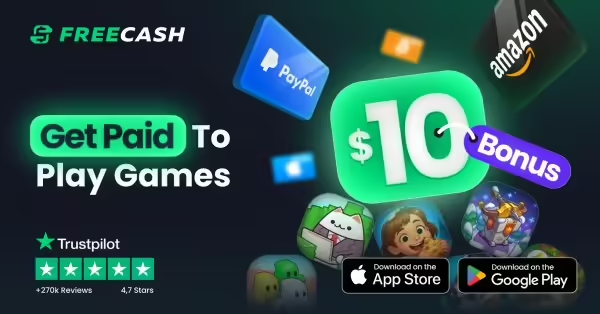
Freecash, owned by Berlin-based Almedia GmbH, had reached number 2 on the United States iOS App Store for multiple consecutive weeks. In January 2026 alone it racked up 5.5 million combined downloads across the App Store and Google Play, jumping from roughly 876,000 in October 2025. Downloads peaked at nearly 6 million in February. By April it was on track for around 3 million installs in the month, still placing it inside the top 7 on the United States chart and number 13 on Google Play before removal.
The TikTok Hook That Was Never Real
Most of those downloads were funnelled in through TikTok. A wave of sponsored short-form videos showed a young woman acting as if she had been hired by TikTok itself to scroll the For You feed for money. The ads quoted earnings of up to 35 dollars per hour. Crucially, many of the clips never named Freecash. The landing pages combined the TikTok logo with the Freecash logo and offered to let users cash out instantly. TikTok itself eventually pulled a batch of these ads in January for breaching its rules on financial misrepresentation, and removed many of the third-party creator videos that pushed the same false claim.
Almedia's response to the TikTok takedown was that the most misleading material had been produced by third-party affiliates rather than the company. That defence is undermined by Almedia's own affiliate program, which pays creators to promote the app across social platforms. In other words, the same campaign machinery that fed the bogus 35-dollar TikTok offer was a feature of the business, not a leak from outside it.
What Users Actually Earned
After installation, the promised TikTok paycheck disappeared. Users were instead pushed into a rotating list of mobile games such as Monopoly Go and Disney Solitaire and offered tiny cash rewards for completing time-limited challenges inside those titles. One Monopoly Go offer paid roughly 1 cent for two minutes of play per day. A 123 dollar payout required reaching level 300 in under three months, a target most casual players cannot hit without spending real money on in-app purchases. The game-publisher side of the deal explicitly looks for users likely to spend, which is exactly how Freecash markets itself to advertisers.
The Data Trade Behind the Rewards
The deeper problem is what Freecash collects in exchange for those small payouts. According to a January 2026 Malwarebytes investigation, the platform's privacy policy permits the automatic gathering of highly sensitive information including race, religion, sex life, sexual orientation, health and biometrics. Each additional mobile title installed through the offer wall comes with its own tracking and telemetry, multiplying how much behavioural data flows back to advertisers and brokers. Researchers have warned that data brokers already trade lists of people more susceptible to scams and compulsive online behaviour, and that platforms like this can sharpen those profiles.
Forum reporting added that the app appeared to use participants' WiFi and mobile connections as part of a residential proxy network, with operators charging downstream clients for traffic routed through real consumer IP addresses while the app was open. That claim has not been confirmed by Almedia.
Inflated Reviews and Affiliate-Powered Hype
Freecash carried a 4.8 star score on Trustpilot from roughly 273,850 reviews and a 4.7 star score on the App Store across more than 150,000 ratings at the time of its removal. Those numbers are heavily contaminated. The same affiliate program that paid creators to flood TikTok with the 35-dollars-an-hour pitch also rewarded users for promoting and reviewing the platform, which is the textbook definition of incentivized review activity. TechCrunch's reporting flagged probable fake ratings, suspiciously favourable Google backlinks and the apparent use of bots to push the listing up the charts. Several consumer-tech outlets have noted that the inflated star count likely contributed to Apple missing the app for as long as it did, since high ratings are a signal the App Store generally treats as positive.
A Banned App That Came Back Through the Side Door
Almedia first submitted Freecash to the App Store on March 24, 2024. Apple removed it on June 13, 2024 after roughly 69,500 downloads. Months later, an existing App Store app from Cyprus-based 256 Rewards Ltd was rebranded as Freecash and updated under a different developer account. That app, originally listed simply as Rewards, was renamed only about five months before its meteoric chart climb. Re-entering the App Store under a separate developer account after a ban is a known and explicitly rule-breaking tactic. Almedia's spokesperson declined to comment on the earlier takedown.
The Company's Defence
Almedia denies wrongdoing. In statements distributed to multiple outlets, the company said its apps are fully compliant with Apple App Store and Google Play Store policies, as demonstrated by the fact that they are live and regularly pass platform reviews, and that it does not comment on internal product strategy regarding specific app listings. CEO Moritz Holländer added on LinkedIn that Almedia is appealing through Apple's official process and wants to work with Apple on a permanent resolution.
The company has also reminded reporters that its model has paid out more than 50 million dollars in total to users, with more than 13 million euros withdrawn in the past 30 days, that average time to a first reward is listed at 17 minutes 12 seconds, and that the FT1000 ranking named Almedia the fastest-growing advertising company in Europe and the third fastest-growing company on the continent overall.
The Crypto Payout Angle
Freecash sits adjacent to the play-to-earn space because it offers cryptocurrency as one of its withdrawal methods alongside PayPal, bank transfer and gift cards. That positioning has helped it leak into web3 communities that are accustomed to earning small balances through gameplay activity, and into German consumer media that have flagged the model as questionable. The German consumer-tech outlet Chip described the business as a fragwürdiges Geschäftsmodell, or questionable business model, in coverage of the 35-euro-per-hour scrolling claim.
Almedia has continued to expand into adjacent verticals despite the controversy. It acquired German cashback service zave.it on August 14, 2025 and launched Freecash cashback in Germany on December 1, 2025 with retail partners including Rewe, Lieferando, Acer and Adidas. The company says around 65 percent of those cashback users are engaging with cashback for the first time, which it markets to advertisers as an unusually fresh audience.
What Happens Next
For now, the Freecash native app is gone from both the App Store and Google Play. The web version remains accessible. Almedia has filed an appeal. Apple, having already terminated the developer account, has pointed to its broader anti-fraud track record rather than committing to any structural change in how rewarded user-acquisition apps are reviewed.
Reporters have noted one number that captures the asymmetry of the situation. Almedia spent more than 100 million dollars on user acquisition in 2026 alone, across DSPs, television and social, on the assumption that Apple's 2025 guideline update had legitimised the rewarded category. Anyone who downloaded the app on the strength of that spend handed over personal data ranging from religion to biometrics in exchange for a few cents per session of Monopoly Go.