PlayToEarn




 Plus
Plus



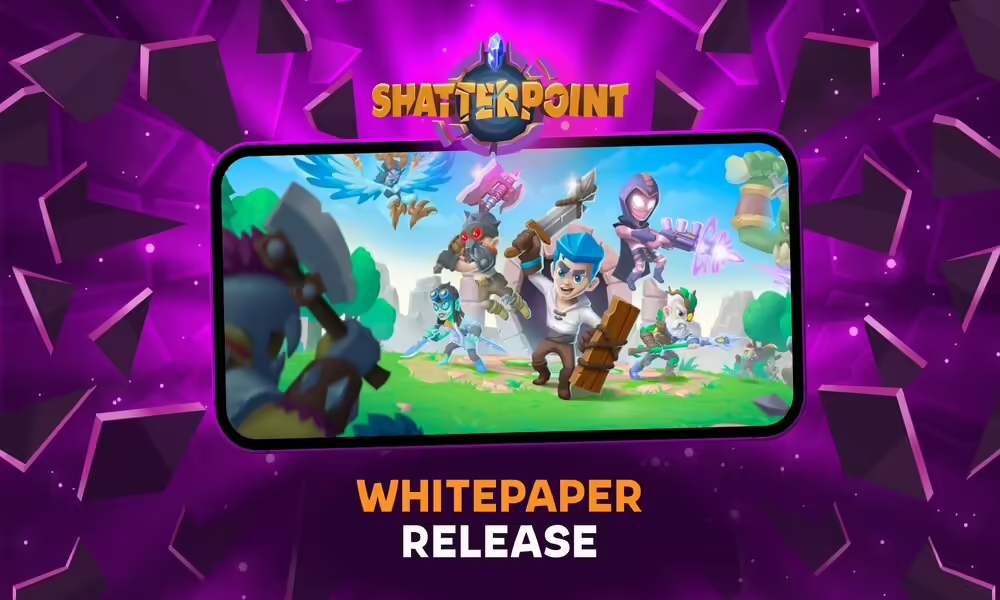
The whitepaper for Shatterpoint is now officially live, giving the blockchain gaming community all the important details about this web3 game to get ready for the upcoming Season 1 launch.
What is Shatterpoint?
Shatterpoint is a free to play RPG and MOBA in which you collect Shards and complete objectives across dynamic battlefields in fast-paced 3-player matches as customizable heroes to climb leaderboards and win crypto rewards.
Following two failed versions since 2021, and then almost two years of co-development with Big Time and Open Loot, the team is now ready to publicly release their top-down title across mobile devices on both Android and iOS. In April this year, they launched an Early Access Airdrop Campaign, while June was marked by the announcement of the Play to Airdrop Campaign ahead of $POINT token TGE. With the whitepaper now live, we have more info than ever on everything we need to know about this game to get ready to play to earn in Season 1. Let’s dive in!
What Does the Shatterpoint Whitepaper Reveal?
The new whitepaper gives us in-depth info on the gameplay mechanics, marketplace, and in-game economy of Shatterpoint.
When it comes to gameplay, we find out that there will be 5 distinct heroes to play with in fast-paced PvPvE matches. Each hero has 2 of their own abilities and are suited for different playstyles. Every match consists of a total of 3 players, who are tasked will collecting as many Shards as possible within a limited amount of time. These Shards are dropped by hostile monsters and can be found in hidden chests scattered throughout the map. They can also be earned by completing shared quests during a match. Every player gets the same 3 quests, and the first player to complete a quest gets to take the Shard rewards. Lastly, you can also try and steal Shards by taking down other players, claiming 20% of their stash.
While your choice of hero does affect your playstyle, you can add further strategic depth to gameplay by customizing them with varied gear and up to 4 runes. Equipment such as weapons, armor, and accessories can be crafted and upgraded with Shards or premium currency Quantum Dust to improve stats such as speed, attack power, and defense. Runes not only boost your stats, but also give you special abilities, and they can be crafted using either Shards or Quantum Dust, just like with gear. To truly own your assets and make them even more powerful, there will be an option to infuse $POINT tokens with items in order to craft digital collectables.
Next to the chaotic PvPvE action, players can also look forward to limited time boss fights. These PvE events are solo battles that award rare resources, $POINT tokens, and exclusive collectibles. Entry requirements to these boss battles may vary from one event to the next. Some boss fights may ask you to hold a certain NFT and pay an entry fee in $POINT tokens, while others may have you meet certain tier requirements and ask you to pay an entry fee in Shards or Quantum Dust without needing to own an NFT. This means some events will be more accessible to web2 gamers, but those will come with scaled down rewards as a result, with on-chain prizes reserved for the web3 exclusive events.

When it comes to the marketplace, the team has teamed up with Open Loot to allow you to trade 3 main types of special in-game items on their platform: Equipment Collectibles, Cosmetic Collectibles, and Utility Collectibles. Each collectible comes with a fixed supply and is craftable in-game while being tradable on the partnered marketplace.
Equipment Collectibles, Cosmetic Collectibles, Utility Collectibles, and the $POINT token are what make up the in-game economy, and if you’re familiar with the Open Loot gaming ecosystem, then you probably already have a good idea of how the web3 side of this game works.
While Equipment Collectibles can be crafted using in-game resources and $POINT tokens, those who want to make cosmetics will need to buy a Cosmetic Printer, either from the game or through the Open Loot marketplace. Only with the Cosmetic Printer is it possible to start crafting various cosmetics that turn into tradable assets which potentially give you access to exclusive events such as boss battles while increasing your $POINT earnings by a certain percentage. This token earnings bonus depends on the rarity and exclusivity of the cosmetics you equip your hero with.
Utility Collectibles are special items and tools that include Crystals and Crystal Forges. Crystals are what make it possible to earn $POINT tokens by winning PvP matches, while Crystal Forges are needed to craft and infuse Crystals. Crystal Forges have to be purchased either directly from the game or the marketplace, after which you can use in-game recipes to craft Crystals, and then infuse them with Dust to activate the Crystal’s ability for earning $POINT tokens. The number of matches you can use a Crystal depends on how much you charged it at the Forge. A Short Charge lets you play to earn in 6 PvP matches, while a Medium Charge gives you 15 PvP rounds, and the Long Charge enables play and earn gaming in 30 PvP matches.
Check out the whitepaper linked in the official X announcement to learn more.
How to Play to Airdrop in Shatterpoint Season 1
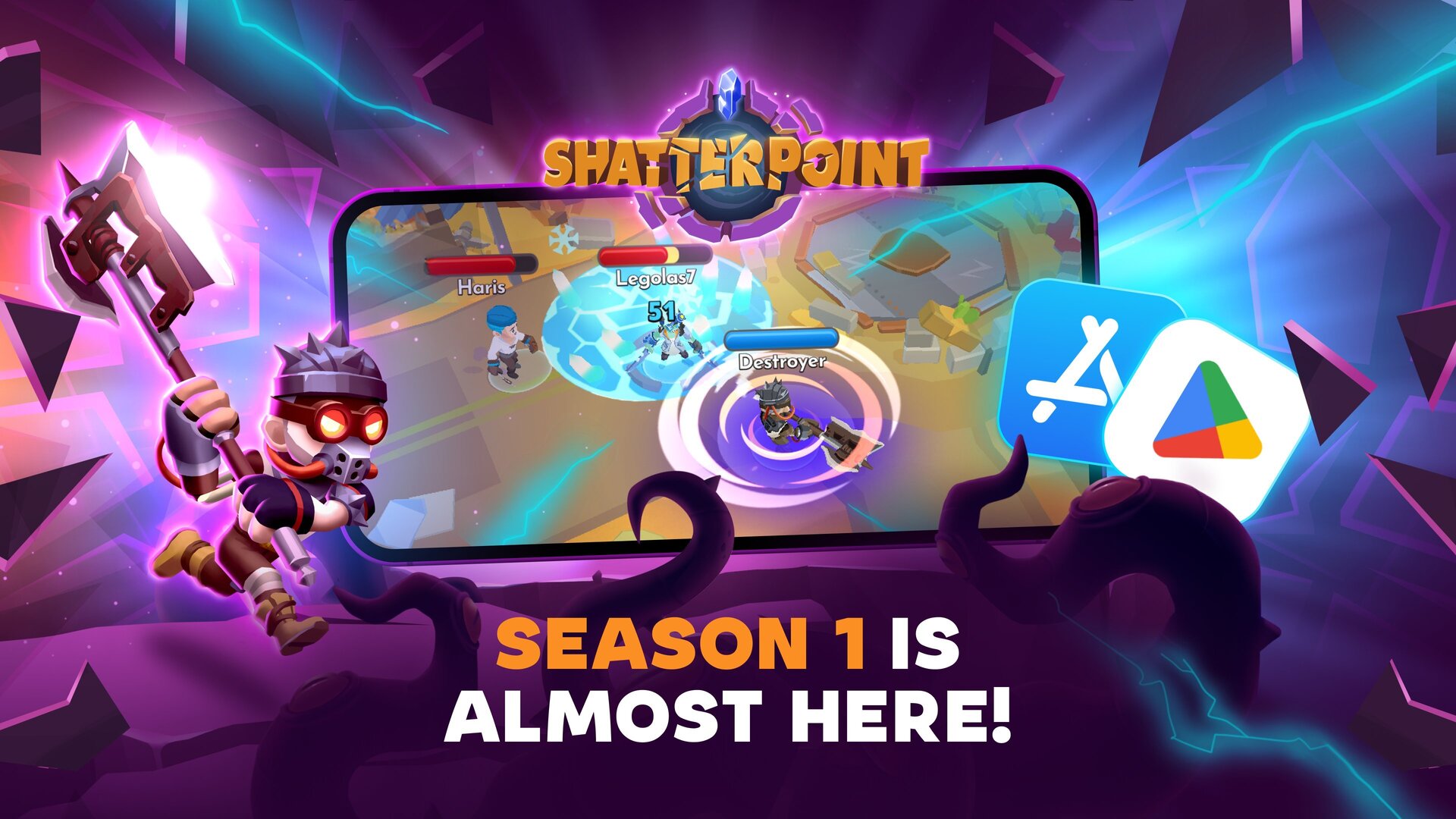
The upcoming Season 1 of Shatterpoint adds in PvP gameplay and a global leaderboard, making it possible for anyone to play to airdrop the $POINT token.
To play to airdrop, players will attempt to complete a variety of gameplay tasks in order to earn points determining leaderboard position, with the top 1000 highest-ranked players on the game’s ladder set to receive airdrop points called Spark. The higher your rank, the more Sparks you’ll earn, meaning a potential higher airdrop allocation of the $POINT token.
To climb the leaderboard, you will earn points by completing activities such as crafting challenges, PvP achievements, equipment-based tasks, monster hunting goals, and special event objectives. You will be able to see all these quests through your player dashboard. These missions are a part of a weekly task system that will let you complete the same task multiple times to earn more points. However, a weekly cap will be in place in order to ensure fair distribution of Sparks to all active and dedicated players.
At TGE, you will be able to convert your Sparks into $POINT tokens at a certain exchange rate. Until then, all in-game activities that would normally require using $POINT tokens can be done with Sparks instead. No official starting date for Season 1 is available at the time of writing, nor is there $POINT tokenomics or a TGE date yet. The team seems to be waiting on Apple to approve the game for their App Store, so it looks like Season 1 will kick off very soon. Learn more about other potential ways to earn Sparks in the whitepaper’s dedicated P2A section.