PlayToEarn











 Plus
Plus



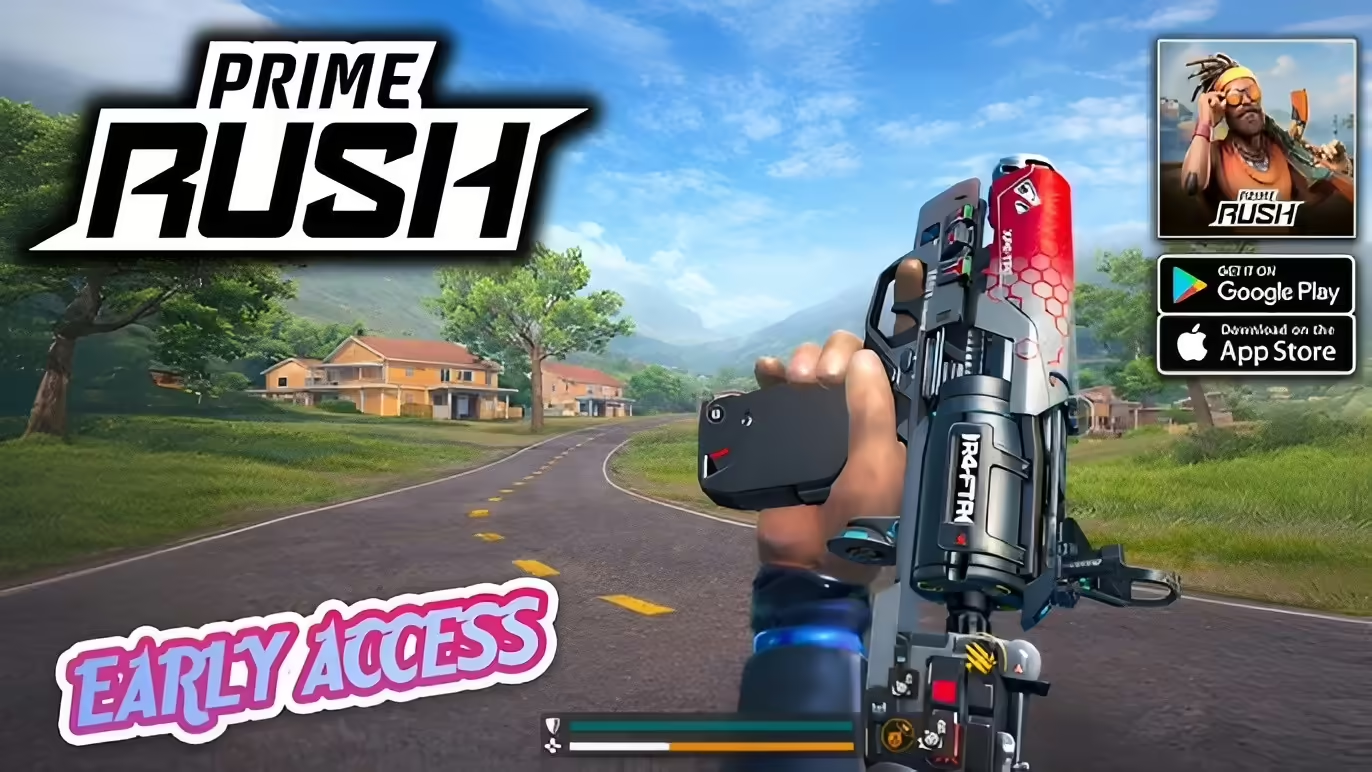
LATAM Servers Go Live for Prime Rush
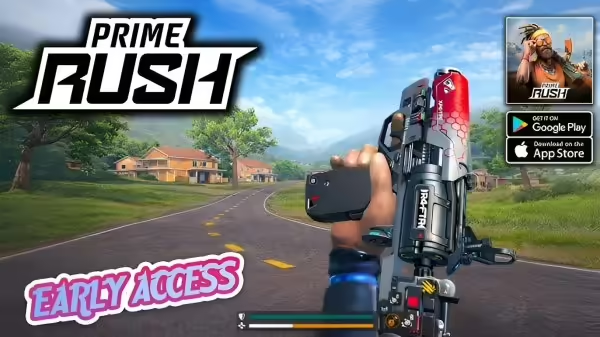
The SUP Foundation has confirmed that LATAM servers for Prime Rush are online. The mobile battle royale is now available free of charge across the region on both the App Store and Google Play, with the official announcement framed as The wait is over, LATAM.
Prime Rush launched in Brazil on March 16, 2026 as a regional exclusive, built in partnership between Indian studio SuperGaming and Spacecaps, the parent company of Brazilian esports organisation LOUD. The wider LATAM rollout is the next scheduled step in the game's staggered release strategy, following months of feedback from a closed beta and an early access phase in Brazil.
How Prime Rush Plays
The title mixes classic battle royale survival with extraction-shooter objectives, a combination the team has been pushing as a way to differentiate from the Free Fire and Call of Duty Mobile competition that dominates the region. Matches run 10 to 15 minutes across Solo, Duo, and Squad modes, and give squads two parallel win conditions: either be the last unit standing, or collect and extract Cosmium, a rare resource that spawns in the final phase of a match.
Players pick from a roster of Brazilian-inspired heroes including Juliana, Raphael, and Rogério. Each hero can slot in tactical abilities that change how a fight plays out. Dead Eye spawns a powerful weapon that one-shots on headshots and refills ammo with every kill, Shield Dome drops a barrier that blocks incoming fire but lets allies shoot outward, Super Speed boosts movement for a window, and Hunter Instinct reveals enemies on the map and activates infrared vision for clear spotting.
The launch build ships with Ranked Season 1, a Battle Pass called Street Legends, and a rotation of limited-time modes including DeadEye Rush, Pants in the Air, and Weapon Roulette. The ranked ladder runs from Bronze through Silver, Gold, Platinum, Diamond, Champion, Legend, and Cosmic. The game also includes a 4v4 mini team deathmatch map called Favela for quick sessions between full battle royale matches.
Built for Mobile-First LATAM
The system requirements are tuned for a market where mid-range phones dominate. Prime Rush runs on Android 7 and above with 4GB of RAM and iOS 15 and above, targeting a stable 40 FPS on lower-end devices and up to 60 FPS on mid to high-end hardware. SuperGaming has flagged that it is continuing to optimise the game for more devices over time. Voice chat, custom controls, and multiplayer matchmaking are built in.
The technical backbone is SuperPlatform, SuperGaming's proprietary tech stack designed for hyperscale real-time multiplayer. The studio has used the same platform across earlier hits including MaskGun, Silly Royale, Tower Conquest, Battle Stars, and Indus Battle Royale, a combined portfolio that has tallied more than 200 million installs to date.
The LOUD Connection and the LATAM Strategy
Prime Rush's regional push runs through LOUD, one of the largest gaming and esports organisations in Latin America, and its parent company Spacecaps, which handles publishing, distribution, and media for the game across the region. LOUD was founded in 2019 and operates competitive rosters across VALORANT, League of Legends, Free Fire, and Brawl Stars.
The partnership is not new. Spacecaps participated in SuperGaming's Series B funding round earlier this cycle, part of a 14.93 million dollar raise, roughly INR 131 crore, which brought SuperGaming's total funding to 20 million dollars. Other backers named in that round include Skycatcher, Steadview Capital, a16z Speedrun, Bandai Namco 021 Fund, Polygon Ventures, Neowiz, GFR Fund, IVC Japan, 32Bit Ventures, and Polygon cofounder Sandeep Nailwal. LOUD CEO Bruno Bittencourt has publicly described the Prime Rush collaboration as a significant step in bringing authentic gaming experiences to the LATAM community.
The strategy behind the partnership is explicit: rather than porting a finished product into a new region, SuperGaming and Spacecaps have been co-developing Prime Rush with Brazilian players and creators during beta. That co-development angle is the company's answer to a pattern that has bruised plenty of global mobile shooters in LATAM, where shallow localisation tends to burn off interest within a few months.
Where Web3 Fits In
Prime Rush is officially announced by the SUP Foundation, which is the onchain arm of SuperGaming. That framing matters. The SUP Foundation formally came out of stealth in August 2025 with a stated goal of bringing more than 200 million lifetime SuperGaming players onchain, anchored by a custom L3 blockchain called GameChain, built in partnership with B3 on top of Coinbase's Base network.
GameChain sits alongside other B3 gamechains including Godchain from InfiniGods for mobile games, Primechain from Parallel Studios for PC, and the Echelon Prime Ecosystem. The model allows each studio to customise its own chain while sharing network effects and revenue across the wider Open Gaming environment. GameChain is being built to support wallet-native onboarding, in-game asset ownership, and deeper blockchain integration for free-to-play titles. B3 itself launched its token earlier in 2025 and now reports more than 200 million transactions processed and over 6 million wallets onboarded.
Part of SuperGaming's Series B capital was ring-fenced specifically for expansion into Latin America and the Middle East, with Prime Rush and Indus Battle Royale flagged as the spearhead titles for the LATAM push. The SUP Foundation's first onchain move was the Lotus Vault NFT mint in mid-August 2025, pitched as an early community access point and the starting ID layer for the SUP ecosystem ahead of the GameChain rollout.
At launch, Prime Rush is not a crypto game. It runs and earns like a standard free-to-play mobile battle royale with a battle pass and cosmetics economy. The Web3 angle sits at the parent-foundation level: every player who drops into Prime Rush in Brazil or the rest of LATAM is a funnel into the SUP Foundation's broader onchain roadmap, which is why the LATAM switch-on was posted from the foundation's official channel rather than a straight publisher account.
Market Context
LATAM's appeal to mobile-first studios is mechanical. Smartphone penetration is high, data plans are affordable, and competitive player communities are dense. Brazil alone is one of the largest battle royale markets in the world, built on years of Free Fire dominance. At the same time, multiple globally successful mobile shooters have failed to sustain engagement in the region, which analysts have repeatedly attributed to shallow localisation layered on top of systems designed for other markets.
On the India side, which is SuperGaming's home market, mobile gaming revenue is projected to hit 9.2 billion dollars by 2029, up from 3.8 billion dollars in 2024, with a forecast 724 million gamers over the same window and in-game purchases growing at a 44 percent compound annual rate. Roughly 81 percent of Indian players use smartphones under 400 dollars, and 90 percent rely on low-data plans, a player profile that Prime Rush's performance targets are explicitly designed to serve.
What To Watch Next
The current Brazil-first build already includes Ranked Season 1 and Battle Pass Season 1 Street Legends. Post-launch, SuperGaming has framed the LATAM rollout as an iterative process, with continued regional tuning expected after release. The game's first-ranked season, the Cosmium extraction loop, and the limited-time mode rotation are the core pillars the team will be stress-testing against the wider LATAM player base.
On the onchain side, the LATAM expansion is the last major piece of SuperGaming's Web2 distribution before GameChain's full rollout wires its player base into the B3 Open Gaming ecosystem. One figure from the studio frames the scale of the bet most cleanly: SuperGaming is targeting a 200 million plus player base for its onchain transition, and LATAM is now officially part of the funnel.