PlayToEarn



















 Plus
Plus



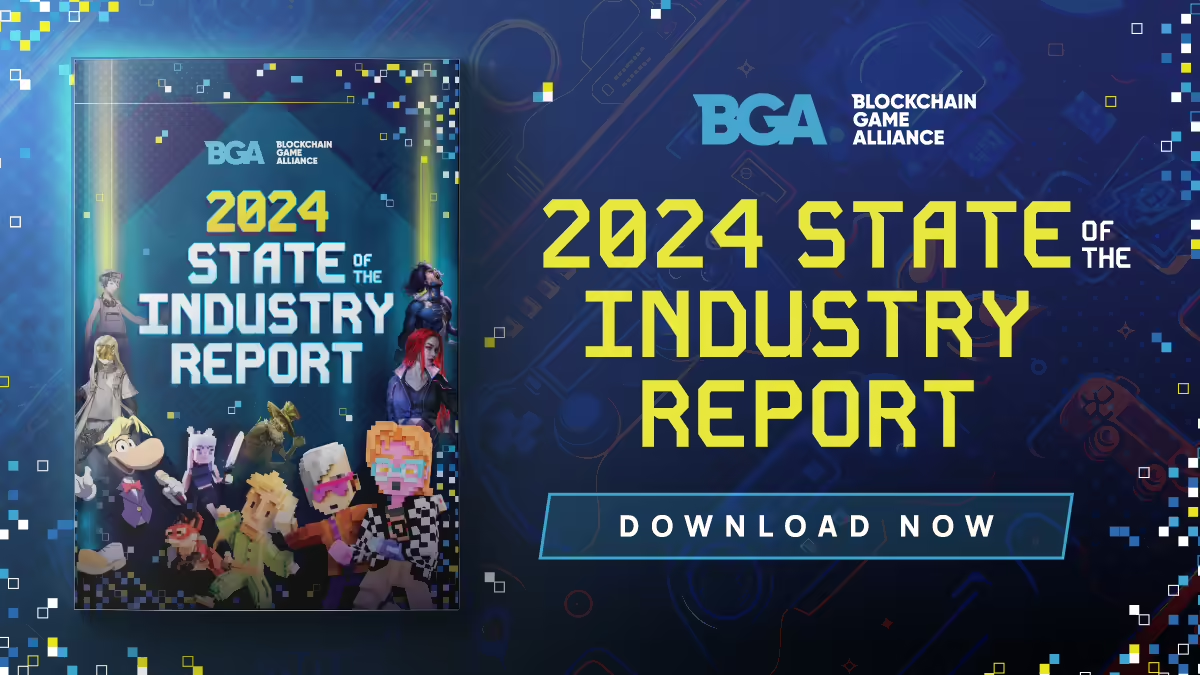
The Blockchain Game Alliance (BGA) has published its 2024 State of the Industry Report, and it’s full of insights into where web3 gaming is heading. Over the past year, we’ve seen a clear shift from speculative P2E models toward making fun-first games that put power to the players. The report highlights how web3 gaming is becoming more enjoyable, accessible, and sustainable. Here's how crypto gaming evolved in 2024 and what lies ahead.

From Crypto to Gaming-First
For the first time in BGA’s survey, over half of blockchain gaming professionals—52.5%—come from gaming backgrounds, not web3 or crypto. This marks a big shift in how the industry sees itself. Games are no longer designed with blockchain as the core focus; instead, blockchain has become a supporting tool to enhance gameplay and ownership.
Now, this matters a lot because it brings fresh perspectives from people who have years of experience making games that players love. It’s also a step away from “financialized gaming,” often criticized for focusing profit over fun.
Kurt Watkins, Founder of Watkins Legals, explains:
“Web3 gaming has evolved from its crypto-driven, financialized origins into a space where fun-first games take the lead. Early crypto-centric efforts laid the groundwork, proving the potential of the space and giving gaming-focused developers the confidence to invest the time and effort needed to create expansive, immersive experiences.”
With that, the space is becoming more focused on games that feel familiar to mainstream players while also offering the perks of blockchain tech.

Ownership Matters More Than Ever
The report also confirms that digital asset ownership remains the biggest reason for blockchain’s value in gaming, with 71.1% of respondents naming it as the top benefit. This has been a consistent theme since 2021. It’s easy to see why—ownership changes everything. It means players can keep, trade, or sell their in-game items instead of being locked into a single platform.
This year, we’ve seen notable advancements in web3, proving just how far asset ownership has come:
- Dynamic NFTs: These tokens evolve or change based on a player’s progress, achievements, or external events. For instance, a weapon NFT could level up after a series of battles, or a character’s traits could adapt to match a player’s choices. This creates a deeper, more personal connection between players and their game assets.
- Soulbound Tokens (SBTs): Unlike NFTs, SBTs are non-transferable, acting as permanent records of a player’s achievements, credentials, or reputation. These tokens pave the way for identity-based gaming, where a player’s profile is tied to their journey and accomplishments.
- Token-Gating Mechanisms: By using NFTs or fungible tokens, developers can grant exclusive access to in-game features, curated content, or private events. For instance, players holding a certain NFT might unlock hidden quests, VIP tournaments, or limited-time rewards. This improves the utility of digital assets while creating new revenue streams for game makers.
- ERC-6551 Wallets: ERC-6551 take NFTs to the next level by allowing them to act as smart contracts. These NFTs can hold other assets, execute transactions on its own, and even interact with AI systems. For example, an NFT character could carry its own inventory of items or autonomously trade assets with other NFTs. This unlocks new layers of interactivity never before seen in gaming.
- Interoperability All Across: True ownership means players can seamlessly take their assets across different games and platforms. A character skin or weapon NFT earned in one game might be usable in another, reinforcing the asset’s utility. This creates interconnected platforms where assets hold real value beyond a single title.
All of these innovations align with emerging benefits cited by respondents, such as new revenue models (42.2%) and reward systems (42.4%).
Hilmar Veigar Pétursson, CEO of CCP Games, sums up perfectly:
“We are, in fact, no longer owners of the items that enrich our lives; we have become virtual renters. With the technological and legal framework that blockchain affords, we can regain and become owners of our digital property.”

The Evolution of Player Rewards
The play to earn (P2E) model was once the face of web3 gaming, especially during the Axie Infinity boom. While it proved the potential of blockchain to help players earn money, it wasn’t without flaws. Many critics said P2E games often focused too much on earning, which led to unsustainable economies and shallow gameplay.
Over time, this model has evolved into play and earn, where the focus is now on fun, with earning prospects as a bonus. This year, a newer model called play to airdrop (P2A) has gained traction. Unlike P2E, P2A rewards players based on the time and effort they invest in gameplay. Rewards are tied to achievements, offering meaningful rewards without flooding the market with tokens.

Based on the BGA report, play to airdrop brings a more sustainable way to reward players. Instead of relying on constant token emissions, players receive one-time rewards, such as airdropped tokens or NFTs, for specific actions or milestones. This keeps rewards valuable and avoids inflating economies. For instance, Notcoin's P2A event stands out as one of the most successful in web3 gaming. During its airdrop, the game distributed over 80 billion $NOT tokens to its users, with some reportedly earning as much as $19,500!
Another exciting trend is the rise of create to earn systems, where user generated content (UGC) is rewarded, promoting both creativity and community ownership, enhancing the sense of value to the player. Other than that, SocialFi questing rewards players for interacting with others, making player engagement a key part of the ecosystem.
Questing itself, while a long-established mechanic in mainstream gaming, is becoming a core reward system in web3. By tying rewards to specific challenges or milestones, questing offers a structured and strategic way for players to earn. Notably, it also addresses concerns about inflationary token supplies by making sure rewards are tied to meaningful actions.
Nicolas Pouard, VP of Strategic Innovation Lab at Ubisoft, says it best:
“Today, play to earn continues to evolve, focusing on incentivizing constructive behaviors rather than extractive ones, fostering creativity through user-generated content, and promoting more community-driven economies.”

Breaking Down Barriers
Despite progress, onboarding and poor user experience (UX) remain web3 games' biggest challenges, cited by 53.9% of respondents. This percentage however is a huge improvement from the previous year of 79.5%, a positive sign that games have shifted focus onto simplifying the experience.
For instance, free to play mechanics and gasless transactions have lowered the barriers to entry. In gasless systems, developers or trusted relayers cover the gas fees, so players don’t need to worry about crypto transactions. Likewise, layer-2 scaling solutions bundle multiple transactions off-chain before finalizing them on mainnet. This drastically reduces costs and improves speed, making the experience smoother for players.
By removing the need for upfront fees, NFTs, or prior crypto knowledge, these changes have created a seamless entry point for newcomers. Players can try crypto games without pouring in money or dealing with technical hurdles, helping to fight misconceptions that web3 gaming is “too complicated.”
But challenges still exist. A lack of understanding of web3 concepts remains a major issue, with 33.6% of respondents citing this in 2024. While efforts to educate both players and developers are ongoing, clearer communication is needed. Many misconceptions come from the complexity of blockchain apps in gaming. Streamlined processes and clear explanations will help explain blockchain’s benefits without overwhelming new players.
As such, there’s still work to be done. Jason Brink from Gala Games says:
"The core challenge to massive adoption of web3 gaming lies in the unnecessary philosophical separation of web2 and web3, when fundamentally, it should all just be ‘gaming.’ Removing this barrier by focusing on seamless experiences and real gaming experiences will pave the way for true mass adoption."

Gender Diversity: A Persistent Challenge
Another key barrier is gender diversity. The survey shows that 81.9% of respondents identify as male, while only 17.3% are female. While this is a slight increase from 16.9% in 2023, it still falls short of earlier years. The all-time high for women’s representation was 20.3% in 2021.
The disparity is even more pronounced at the senior level. Among CEOs, Founders, Directors, and C-level execs, 87.2% are male, while only 12.5% are female. This highlights a deep imbalance that goes beyond the general survey results.
While the slight increase in female representation is encouraging, it’s clear that we still have a long way to go in achieving gender diversity. Addressing this matter will require focused efforts to make web3 gaming more inclusive and welcoming to women, especially in leadership roles.

Misconceptions: Scams, Bots, and Skepticism
The biggest misconception that crypto games and on-chain games face is the stigma of being labeled as scams or Ponzi schemes. This concern has been the most cited issue for years. While 66.3% of respondents still encountered this view in 2024, it marks a slight improvement from 70% in 2023. The percentage has fluctuated over the years, with 69.5% in 2022 and 59% in 2021. This small decline might signal growing trust or improved efforts to tackle these concerns. However, the consistent numbers highlight the ongoing need for web3 to build trust and transparency.
Another misconception that web3 gaming continues to battle is that blockchain games aren't fun. In 2024, 46.2% of respondents cited this belief, which stems from the early days when games focused more on crypto than gameplay quality. Over the past three years, studios have made real progress by investing in high-quality experiences that rival web2 gaming.
Some of these include:
- Pixels, which broke 1 million daily active users in 2024.
- Off The Grid, which gained mainstream appeal, reaching over 4 million hours watched on Twitch since its Early Access launch.
Web3 gaming is steadily improving its reputation among gamers proving that it can deliver fun, immersive experiences.
However, a new concern emerging this year is the rise of bots in web3 games. This issue was highlighted for the first time in the BGA survey, with 29.5% of respondents backing the view. Bots can distort gameplay, disrupt economies, and create unfair experiences for genuine players. Respondents ranked this as their 6th most troubling misconception, showing its growing impact on public perception.
The belief that bots dominate crypto games often comes from visible on-chain activity. While policies on bots remain divisive, their presence can hurt fairness and diminish the social aspects that many web3 games rely on. Bots can also stop real players from getting rewarded, adding to the frustration among gamers.
Luckily, developers are using advanced tools to tackle this problem. Anton Umnov, CEO and Founder of Helika, explains why this matters:
“The web3 gaming industry faces the challenge of distinguishing real player activity from sybil behavior. With the growing number of bots, leveraging advanced tools like machine learning has become important for game developers to design mechanics that support real players. That’s why Helika’s infrastructure and data analysts provide insights to identify bots while offering guidance on game mechanics, significantly improving engagement, retention, and monetization for our partners.”
On one hand, Mislos from BitPinas highlights the complexity of bot activity:
"Engagement metrics in web3 games are frequently dismissed as inflated due to supposed bot activity, particularly in Southeast Asia. However, having seen the industry firsthand in the Philippines, which remains as the beating heart of web3 gaming, it’s quite clear that this narrative oversimplifies and overlooks the genuine engagement and growth happening on the ground.”

Web2 Meets Web3: The Power of Big IPs
More and more traditional gaming firms are moving into web3. This year, 18.6% of respondents credited the involvement of web2 companies and IPs as one of the most positive developments in on-chain gaming.
Here’s how some of the biggest web2 studios are using blockchain to drive change:
- Sony is building Soneium, a layer-2 blockchain on Ethereum. The team aims to create tools that return profits to creators and fans, with a testnet for app developers coming up soon. This marks a major step for Sony in connecting its business ecosystem to the web3 space.
- Ubisoft expanded its web3 portfolio by building Captain Laserhawk: The G.A.M.E. on the Arbitrum L3 blockchain. Inspired by Far Cry 3: Blood Dragon, the game will feature guest characters from iconic Ubisoft franchises like Assassin’s Creed and Rayman.
- Nexon continues to work on MapleStory N, with MapleStory Universe, a web3 version of its popular franchise, on an Avalanche subnet. The game includes NFT integration, creating a dynamic marketplace where players can trade assets. What’s more, Nexon allows players to contribute quest ideas, merging player creativity with blockchain mechanics.
- Square Enix is making waves by investing in the web3 platform HyperPlay and preparing to debut its blockchain title, SYMBIOGENESIS. Investors like Delphi Digital and BITKRAFT are backing the project, showing strong confidence in Square Enix’s web3 vision.
- CCP Games, creators of EVE Online, announced EVE Frontier, a web3 space simulation game on Ethereum. The game features two currencies: LUX for in-game transactions and EVE as a utility token with real-world value. EVE Frontier is now in closed beta, and many are eager to see how CCP integrates blockchain into its popular franchise.
- Netmarble launched MarbleX, a web3 gaming platform, and partnered with Immutable to migrate its popular titles like Ni no Kuni: Cross Worlds and Meta World to the Immutable zkEVM chain. This move ensures better performance and scalability for web3 integration.
No doubt, the involvement of these major players marks a shift in perception. Blockchain is no longer seen as a disruptive gimmick but as a tool to create richer, dynamic, and sustainable gaming ecosystems.

Global Growth: A Regional Breakdown
On top of that, web3 gaming is expanding worldwide, with notable growth in emerging markets.
Asia Leads the Way
Asia remains at the forefront of crypto gaming. In Japan, companies like Square Enix are combining blockchain with their rich gaming heritage, while Korea is exploring web3 innovations in mobile gaming. In the Philippines, P2E continues to provide economic prospects, despite evolving into more sustainable models.
Latin America on the Rise
Latin America (LATAM) has emerged as one of the fastest-growing regions for blockchain gaming. The region’s youthful population and high mobile penetration rates make it a perfect fit for web3 gaming. Mariano Rubinstein of Sura GG explains:
“The rise in blockchain gaming throughout LATAM is fueled by strong local partnerships, increased access to education, and rapid adoption in key markets like Brazil and Argentina.”
Europe: A Hub for Innovation
Europe remains a key hub for blockchain gaming, contributing 36.7% of survey respondents in 2024. Studios across the region have adopted an organic approach to web3, focusing on innovation and education. Christina Macedo from PLAY shares that:
“Europe’s shift to blockchain gaming is organic, with major studios engaging early and industry education through events like ETH Paris leading the way.”
North America: Steady but Uncertain
North America remains a key player, with 15.4% of respondents coming from the region. But regulatory uncertainty has slowed progress.
Alex Kosloff from Altura offers a perspective on the region’s future:
“Trump’s return to office could be a pivotal moment for crypto, pushing it into the mainstream and accelerating its adoption in everyday life. As digital assets become part of everyday transactions, it’s only logical that web3 gaming will thrive.”
MENA and Africa: Rising Prospects
The Middle East and North Africa (MENA) and the rest of Africa are showing growing interest in blockchain gaming. In 2024, 4.3% of survey respondents came from MENA, reflecting the region’s expanding investments.

Looking Ahead: What’s in Store for 2025?
As we look to 2025, industry experts highlighted a few key trends that will shape the future of web3 gaming:
1. The Rise of Blockbuster Titles
We’re on the brink of seeing the first AAA blockchain games hit the market. Titles like Off The Grid and EVE Frontier are leading the charge, bringing immersive gameplay and on-chain perks. These games seek to bridge the gap between web2 and web3, offering mainstream-level graphics, storytelling, and player engagement while incorporating features like asset ownership and player-driven economies.
Nicolas Gilot of Ultra sums it up:
“In 2025, Web3 gaming will see the release of its first blockbuster titles, marking a significant shift towards mainstream acceptance. With enhanced player ownership, integrated AI, and evolving economic models, the sector is set to redefine digital entertainment while attracting traditional gamers.”
2. Chain & Infrastructure Consolidation
The web3 space has experienced rapid growth in infrastructure, including new blockchains, developer tools, and marketplaces. But this growth has also led to oversaturation. Moving forward, only the most successful projects will survive, taking most of the market share.
To remain competitive, smaller infrastructure projects may merge with others or be absorbed by larger companies. This kind of consolidation is common in the broader tech space and is set to happen in web3 as well.
3. Web3 Runs in the Background
A growing trend in blockchain gaming is shifting web3 elements into the background. In earlier P2E games, blockchain features were front and center, which often overwhelmed new players. Now, more game devs are focusing on UX and UI that feel familiar to mainstream players.
This focus lets users enjoy smooth, seamless gameplay without having to understand the technical side of web3. In the end, players care most about having fun, while blockchain perks like ownership quietly improve their experience in the background.
4. AI for Personalized Gaming Experiences
AI is moving fast and is set to change blockchain gaming. Developers are already using AI for data gathering and analysis, but the technology is growing even more.
- Gen AI is used to help build game assets, characters, and environments much quicker.
- AI will create customized experiences by learning from how players behave. For instance, games could offer custom tips or adjust NPC interactions based on how players play.
As fully on-chain games and autonomous worlds emerge, AI will play a major role in building dynamic in-game economies, storylines, and player experiences.
5. Enhanced Interoperability
By 2025, interoperability will go beyond simple asset transfers. Players will carry their digital reputation, skills, and achievements across games and platforms. For instance:
- A player’s leaderboard ranking or unique achievements in one game could unlock rewards or opportunities in another.
- In-game items will gain new uses and value as they move across different games.
This change will foster dynamic ecosystems, where player progression feels unified across the metaverse. Interoperability will become key to gaming identity, making way for shared stories and connected economies.
6. Decentralized Esports
Esports events are usually centralized, with developers and organizers in charge of tournament rules, teams, and prize pools. Decentralization can change this, making esports more community-driven.
- Players and fans could vote on rules, team selection, or tournament formats.
- Communities could add to prize pools, creating bigger and more open competitions.
This will align esports closer with player interests while unlocking new prospects for teams and organizers.
In Short: A Bright Future for Blockchain Gaming
The BGA 2024 State of the Industry Report makes one thing clear: web3 gaming is no longer just a buzzword—it’s becoming a real part of the gaming world. With a stronger focus on fun, accessibility, and sustainability, we’re seeing this space maturing in ways that few could have imagined a few years ago.
To learn more, download the full BGA 2024 State of the Industry Report here: https://blockchaingamealliance.net/bga-2024-state-of-the-industry-report/