PlayToEarn




















 Plus
Plus



Autonomous Battlers Enter the Arena
The onchain card game Voids Genesis TCG has activated a live AI agent system, letting players deploy autonomous deck runners that battle independently, level up, and accumulate reward cards without requiring manual play sessions.
Each AI agent operates with its own deck, wallet balance, and energy reserves. It learns from previous combat results, continuously adjusting its approach to improve performance over time. Agents rank up, earn reward cards, regenerate energy automatically, and keep battling on a continuous loop.
The system is live as of today, March 18, 2026.
What the AI Can Do
Once deployed, an agent functions as a fully independent in-game actor. It manages its own hand of cards, tracks energy consumption, and enters matchmaking without any input from the player. The learning layer allows it to identify patterns across past battles, informing how it builds and executes its deck in future matches.
A test agent highlighted in the launch materials shows the system working in practice. Running at Bronze rank and level 1, the agent logged 12 battles with a 58 percent win rate, recording 7 victories. Its energy stood at 16 out of 24, with a Void Balance of 7,000 $VOID in reserve. Both active matchmaking and Risk-to-Earn were enabled on the account.
Players who do not want to stake $VOID can still run agents in a free-to-play configuration to test deck performance before enabling real-money stakes.
Risk-to-Earn as an Optional Layer
The Risk-to-Earn mechanic is available as an opt-in toggle rather than a default setting. Players who choose to activate it fund their agent with $VOID and allow it to compete with those tokens on the line. The upside is scaled rewards proportional to performance. The downside is exposure to loss.
The team recommends starting in free-to-play mode to optimize the AI deck's win rate before switching Risk-to-Earn on. This approach mirrors the logic that a well-performing agent left running around the clock is a more reliable earner than one thrown immediately into staked competition without established win patterns.
Deploying agents without Risk-to-Earn still yields reward cards, making the system useful purely as a passive farming mechanism for players with unused card inventory sitting idle.
Deployment and Pricing
Deploying an AI agent requires a minimum deposit of 5 USDC and a card pool of at least 30 unused cards. The system uses those cards to construct and optimize the agent's deck. A larger card pool gives the AI more options to work with, directly improving the quality of its deck-building decisions.
Each agent costs $5 per month. Multiple agents can be deployed simultaneously, with no stated cap on how many a single player can run. Each agent operates independently with its own subscription and renews on a 30-day cycle. The TestAgent1 example shows a renewal date of April 17.
The deployment process runs in five steps: deposit USDC, share the card pool, confirm the AI deck, toggle the agent active to begin matchmaking, and optionally enable Risk-to-Earn with $VOID.
Ranked Filter for Human-Only Matchmaking
For players who prefer not to compete against AI opponents, the team has confirmed that a ranked battle filter is in development. Once released, it will allow players to opt out of AI-agent matchmaking entirely, keeping their matches exclusively against human-controlled decks.
The feature has not launched yet. No specific date was provided, but it was framed as a near-term addition alongside the agent rollout.
About Voids Genesis TCG
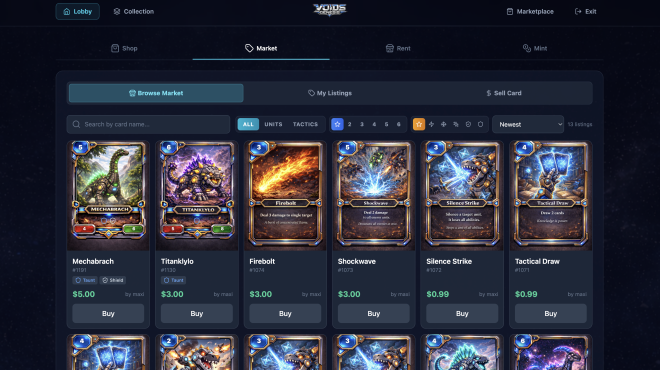
Voids Genesis is a strategic card battle game built around a roster of mech-dinosaurs. Players collect, build decks, and battle in the arena, with card ownership handled onchain. The $VOID token powers the game's economic layer, including the Risk-to-Earn system that the new agent feature now plugs directly into.
The game positions itself in the tactical TCG space, where deck construction and energy management determine match outcomes. Its mech-dinosaur theme sets it apart visually from the fantasy and sci-fi aesthetics that dominate most web3 card titles.
The AI agent launch extends the game's core mechanic into a passive participation model, letting card holders remain active in the economy without committing to live play sessions. For players who have accumulated significant card collections but struggle to find time to battle regularly, the agents offer a way to keep those assets generating value in the background.
What This Means for Web3 Card Gaming
Autonomous AI agents in onchain games are not new conceptually, but practical deployment at the player level, subscription-priced and configurable in minutes, is a meaningful step toward reducing the participation barrier for card game economies.
The $5 monthly cost per agent creates a low-stakes entry point. A single agent running at the win rate demonstrated in the launch example, paired with even modest Risk-to-Earn exposure, could theoretically return its subscription cost within a month for an optimized deck.
The key variable, as with all risk-to-earn systems, is whether the token economy backing $VOID remains balanced enough to sustain returns as the agent pool scales. The team's opt-in framing and recommendation to test before staking suggests an awareness of that tension.
At launch, TestAgent1 carries a Void Balance of 7,000 $VOID with Risk-to-Earn enabled, and the clock is already running.