PlayToEarn



















 Plus
Plus



A Decade of Uncertainty Ends in Washington
For more than ten years, blockchain gaming studios, token issuers, and NFT platforms building in the United States operated in a legal gray zone. Whether a game token constituted a security could mean the difference between freely distributing rewards to players and facing federal enforcement action. That ambiguity defined the environment under former SEC Chair Gary Gensler, whose agency initiated 583 enforcement actions and imposed $8.2 billion in penalties in fiscal year 2024 alone, treating the majority of crypto assets as unregistered securities by default.
That posture is now formally dismantled.
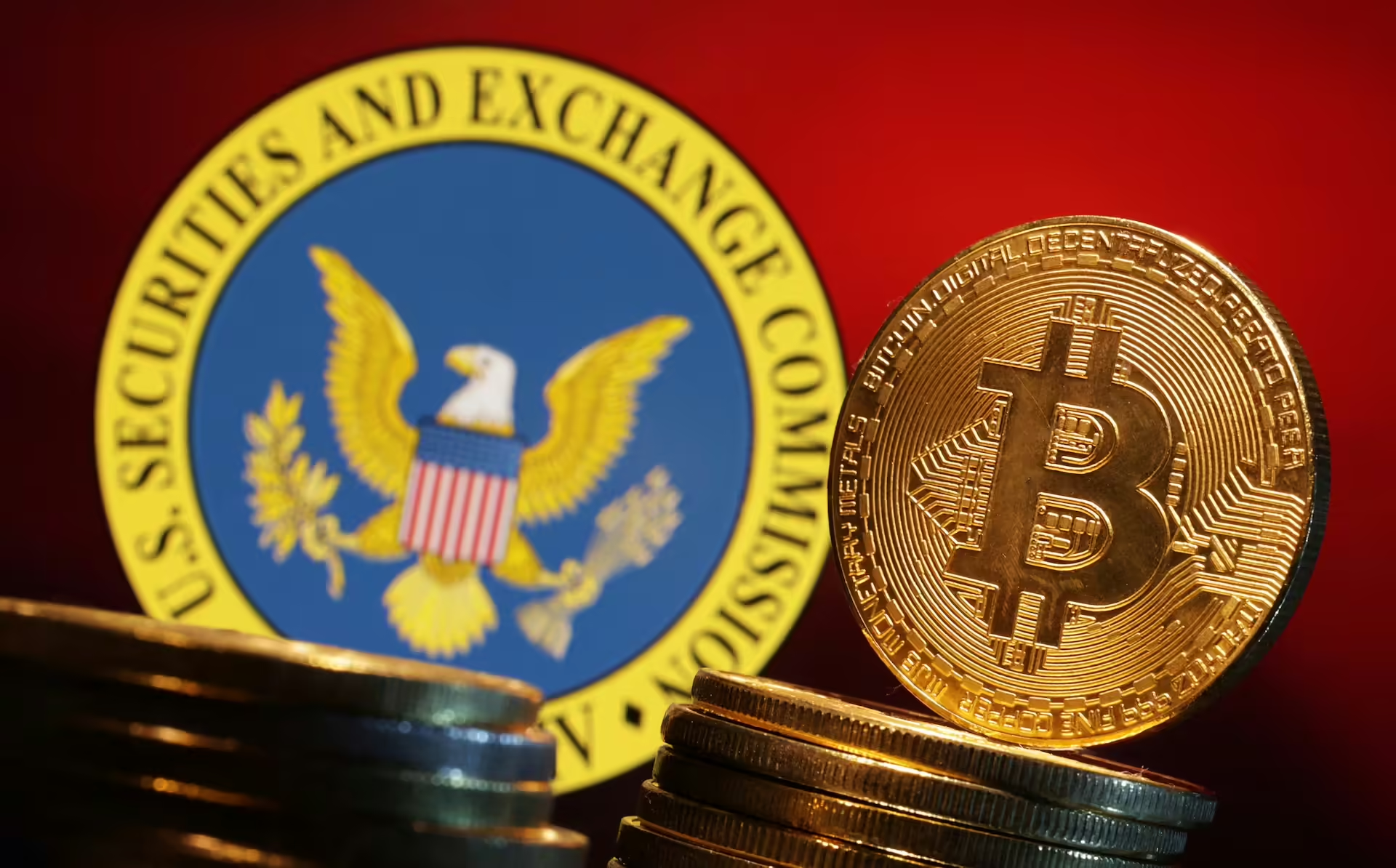
Speaking at the DC Blockchain Summit in Washington on March 17, SEC Chairman Paul Atkins unveiled a 68-page joint guidance document co-issued with the Commodity Futures Trading Commission. It represents the first formal token taxonomy in U.S. regulatory history and draws a direct line between what falls under securities law and what does not.
"After more than a decade of uncertainty, this interpretation will provide market participants with a clear understanding of how the Commission treats crypto assets under federal securities laws. This is what regulatory agencies are supposed to do: draw clear lines in clear terms," Atkins said.
He was equally direct about what the guidance corrects: it "acknowledges what the former administration refused to recognize — that most crypto assets are not themselves securities."
Five Categories, One Regulated
The 68-page document divides crypto assets into five categories. Only one of them falls under U.S. securities laws.
The four categories confirmed as non-securities are digital commodities, digital collectibles, digital tools, and payment stablecoins. Only digital securities, meaning tokens that represent conventional financial instruments like stocks or bonds, remain subject to SEC oversight.
The distinction is grounded in the Howey Test, a legal framework dating to a 1946 Supreme Court case. Under the new interpretation, a crypto asset becomes a security only when an issuer offers it as an investment in a common enterprise with promises of profit derived from that issuer's efforts. Assets that do not meet that threshold are now formally categorized and exempted.
What is new is the concept of temporal expiry. An investment contract ends once the issuer has fulfilled its promises or can no longer fulfill them. That means a token launched under a securities framework can graduate out of that classification as the underlying network becomes sufficiently decentralized.
The CFTC signed on to the same framework as part of a broader harmonization agreement between the two agencies. CFTC Chairman Mike Selig said his agency was signing on to the same taxonomy as part of the two agencies' push toward "harmonization" and added: "I think the signal is clear now that it's time to build in the United States."
Staking, Airdrops, and Mining All Cleared
Three activities that web3 studios have relied on for player incentive structures and community distribution received explicit regulatory treatment in the guidance.
For staking, the SEC says a node operator is carrying out administrative or ministerial activity to secure a proof-of-stake network, and rewards in that context are payment for services rather than profits derived from others' managerial efforts.
On airdrops, the SEC says certain distributions of non-security crypto assets do not satisfy the Howey Test's "investment of money" prong when recipients provide no money, goods, services, or other consideration in exchange.
Protocol mining receives the same treatment. Bitcoin mining rewards, long the subject of legal debate, are now formally outside the securities definition.
For wrapped tokens, a redeemable wrapped token that simply serves as a receipt for a non-security crypto asset does not itself amount to a security. A wrapped version of a digital security, however, retains that status.
What This Means for Web3 Gaming
The category with the most direct impact on blockchain gaming is digital collectibles. The guidance explicitly identifies this class as non-securities and names the assets it covers.
Under the taxonomy, digital collectibles are crypto assets designed to be collected and used and may represent or convey rights to artwork, music, videos, trading cards, in-game items, or digital representations of characters or trends. Purchasers of digital collectibles are not expecting profits from the essential managerial efforts of others.
This is the category that covers the overwhelming majority of gaming NFTs, from character cards and land plots to weapon skins and creature assets. Studios issuing these assets no longer need to treat them as potential unregistered securities offerings. The legal risk that previously required most web3 gaming projects to geo-block U.S. users from token distributions, airdrop campaigns, and staking reward programs is now formally addressed.
For GameFi economies built around reward tokens that meet the digital commodities or digital tools definition, the guidance similarly removes a major compliance overhang. Studios can now issue gameplay reward tokens, run staking programs tied to governance participation, and distribute tokens to players through promotional airdrops without those activities automatically triggering securities registration requirements.
The practical effect extends beyond legal compliance. It changes the economics of building in the United States. For years, the most risk-tolerant web3 gaming studios moved development operations or token structures offshore specifically to avoid SEC exposure. That calculation has now shifted.
What Comes Next
The guidance issued on March 17 is an interpretation, not yet a formal rule. Atkins confirmed that the agency will begin a formal rulemaking process within a week or two, which is expected to be more than 400 pages and will include plans for an innovation exemption for crypto firms.
The SEC and CFTC had already signed a Memorandum of Understanding on March 11, 2026, agreeing on joint market surveillance and coordinated enforcement and officially classifying Bitcoin and Ethereum as digital commodities under CFTC oversight.
Atkins told reporters at the DC Blockchain Summit to "hold on to your seats," adding that the agency is getting dozens of proposals ready, including some on digital assets.
The bipartisan market structure legislation currently moving through Congress, which both Atkins and Selig referenced at the summit, remains the mechanism through which these regulatory changes could become permanent law rather than interpretation subject to future reversal. Until that legislation passes, the token taxonomy remains formally advisory, though it carries substantial weight as the stated enforcement posture of both agencies.
For web3 gaming studios, the immediate window is clear. NFT-based game economies, player reward tokens, staking programs, and airdrop campaigns that fall within the new non-security categories are now operating with the first formal regulatory green light the industry has ever received from U.S. authorities.
"We're not the 'securities and everything commission' anymore," Atkins said on Tuesday. That sentence alone may do more for U.S. blockchain gaming development than any individual studio announcement of the year.