PlayToEarn




















 Plus
Plus




The Thread That Cut Through Industry Noise
More than 2,000 web3 games have launched. Yet the most common complaint across crypto gaming communities remains the same: there are no fun ones.
Kieran Warwick, co-founder of the Illuvium studio, challenged that narrative head-on in a detailed thread published this week. His argument is not that the games are poorly made. It is that players are arriving at them already broken.
"Gamers weren't born web3 gamers," Warwick wrote. "They were gamers who discovered web3. And the moment you can earn money in a game, something irreversible happens in the brain."
His diagnosis centers on a behavioral psychology principle known as the overjustification effect. The concept holds that introducing extrinsic rewards for an activity people already find intrinsically motivating will, over time, erode that intrinsic motivation entirely. Once the brain reframes the activity as a job, the reward becomes the entire point. Remove the reward, and the activity loses its appeal, regardless of its underlying quality.
Applied to web3 gaming, the implication is stark. It is not that the games got worse. It is that the players changed.
Why "Play-to-Earn" Was Always a Trap
Warwick is direct about how this played out across the industry. The play-to-earn framing, he argues, deliberately conditioned an entire player generation to optimize for extraction rather than enjoyment. By leading with monetary upside as the primary hook, studios handed players a framework that guaranteed dissatisfaction the moment token prices dipped or reward pools dried up.
"If monetary rewards are the first thing you push down a gamer's throat, you change their psychology immediately. You don't even stand a chance," he wrote.
The observation carries more weight coming from someone who lived it at scale. Illuvium, at its peak, held $1.6 billion in rewards inside its treasury. That figure represents one of the largest player incentive pools in the history of web3 gaming. It did not solve the retention problem.
"Monetary rewards don't grow on trees," Warwick added. "They run out. For everyone. Regardless of how big your treasury is."
At PlayToEarn.com, we have tracked this cycle across hundreds of titles over the years. The pattern is consistent: high-APY launch, token inflation, collapsing player numbers, abandoned development. Axie Infinity remains the most visible example of the phenomenon Warwick is describing, but it is far from the only one. The games that avoided the cliff were almost universally the ones that prioritized the loop before the ledger.
Two Honest Paths, Not One
Rather than prescribing a single solution, Warwick lays out two approaches he considers legitimate, and notably, Illuvium is actively building one of each.
The first path is to lean fully into the earning premise. Make money the point, design the experience around stakes, and stop pretending the fun exists independently of the economics. This is the philosophy behind Illuvium Deathmatch, a risk-to-earn battle royale format in which players wager their Illuvial NFTs for real money. Defeated creatures are permanently burned. Last one standing claims both the prize pool and the NFTs of every eliminated opponent. "Would I play it without the ability to earn? Honestly, probably not," Warwick admitted. "And that's fine. It's designed for that."
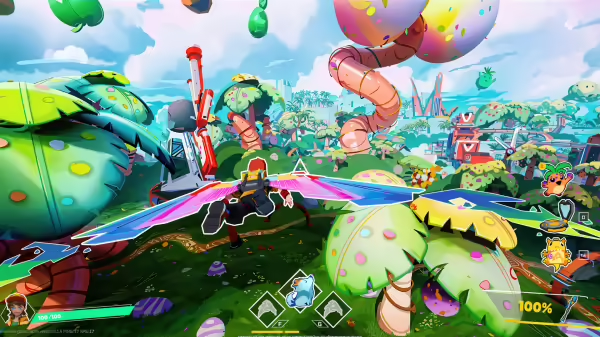
The second path is harder. Build the game so that the loop is compelling on its own, then layer earning on top as a secondary reward rather than the primary motivation. This is the design philosophy Warwick assigns to Illuvium Overworld. The game is built around creature capture, quest completion, exploration, boss encounters, and Ranger progression. Loot that can be sold is the bonus, not the reason to play.
"Getting loot and being able to sell it? That's the cherry," he wrote. "But even here, the balance is razor-thin. Lean too hard on earning, and you topple into the same trap."
The candor about how difficult the second path is separates this thread from standard founder positioning. Warwick is not claiming Illuvium has solved the problem. He is describing the specific design tension that makes it genuinely hard.
Illuvium Overworld: The Fun-First Bet
Illuvium Overworld is currently the studio's flagship development priority for 2025, with the team working to evolve it from an open-world exploration title into a full MMO-lite experience. The transition involves introducing cooperative multiplayer, Leviathan boss raids, expanded progression systems, and new in-game regions, building on existing mechanics rather than starting from scratch.
In its current form, Overworld places players on a hostile alien planet as a Ranger, tasked with capturing Illuvials, gathering resources, completing quests, and uncovering the planet's lore. Creatures are encountered in the wild, weakened through an energy rifle, and then contested in an auto-battler sequence before capture. Illuvials belong to distinct classes and affinities, can be fused in groups of three to evolve into more powerful forms, and carry over as NFTs usable across Illuvium Arena and Illuvium Zero.
The upcoming MMO-lite version targets cooperative raids against Leviathan-class enemies, guild-based progression, player-driven markets, and a shared open world in which players' actions contribute to the broader Illuvium Colony. The studio confirmed in late 2024 that Overworld would become the entire team's focus once Arena reached the quality level of top-tier auto-battlers, a milestone set for Q2 2025.
The economic model connects all three Illuvium titles through the ILV governance token, which players earn through in-game milestones and can stake to participate in DAO voting and revenue distribution. All games are free to play, with optional paid elements layered on top, keeping the initial experience accessible while preserving earning potential for engaged players.
The Uncomfortable Mirror for an Entire Industry
What makes Warwick's thread notable is not that the overjustification effect is a new idea. It is that a co-founder of one of the most funded web3 gaming studios in history is applying it to his own industry in public, naming his own missteps, and using his own platform's nine-figure treasury as evidence.
The conclusion is not pessimistic. But it is demanding. Studios that want to build the next generation of onchain games will need to solve a problem that is not technical and not economic. It is psychological.
"If your game isn't fun without the money," Warwick wrote, "it was never a game. It was a job with better marketing."
The studios that figure out how to make players forget, even briefly, that they are playing for something other than the game itself may define what web3 gaming actually becomes.